
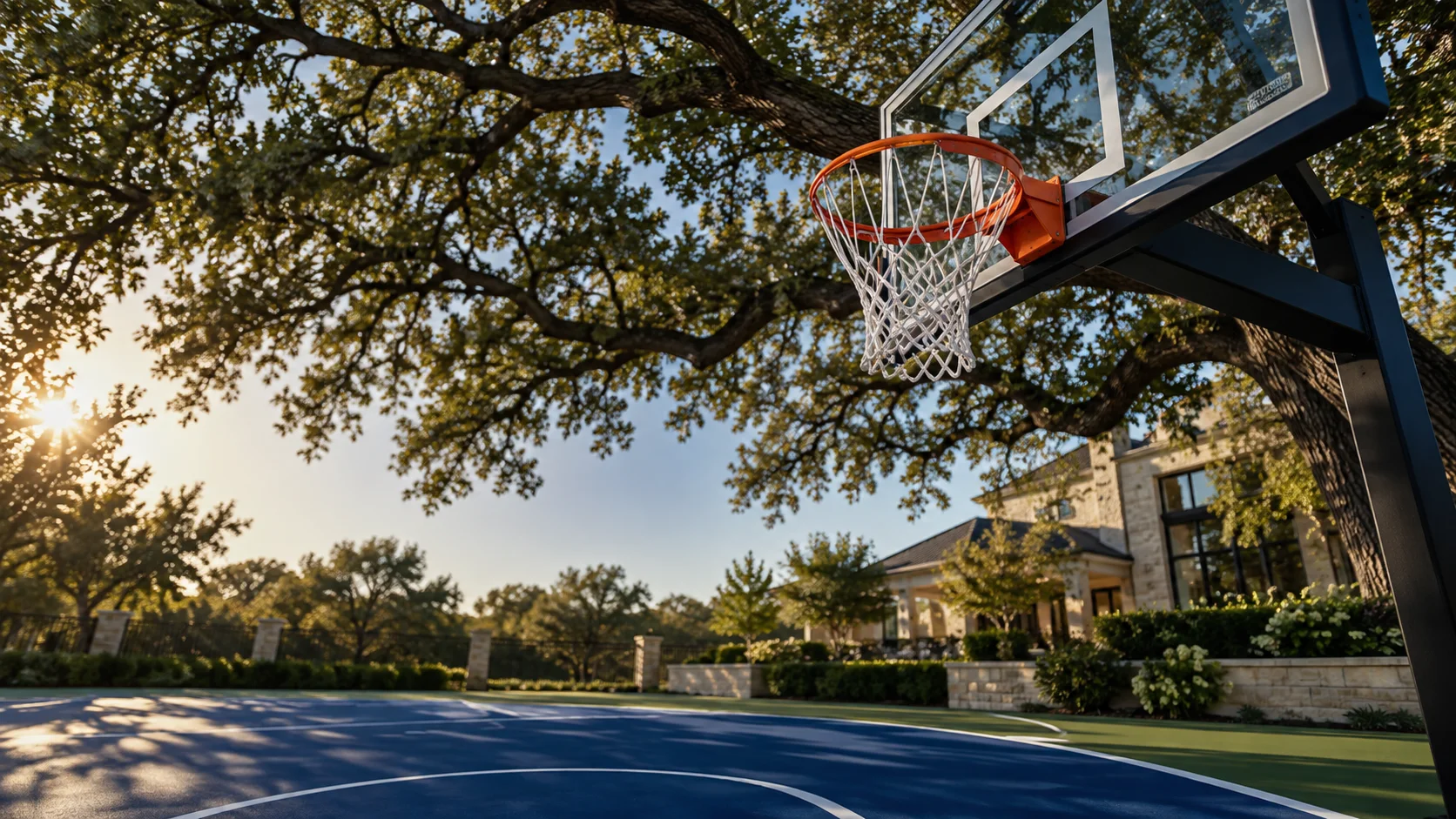
Backyard Basketball Courts in Dallas–Fort Worth
Build or resurface a backyard basketball court in DFW. Explore half-court layouts, driveway conversions, hoops and Laykold surfacing with TX Pickle Courts.
Choose a pad and hoop package, then review the assumptions behind the range.
Begin with the way your family plays
A shooting pad, a generous half-court and a shared game court solve different problems. We define the intended play before assembling the concrete, surface and equipment scope.
- Ground-up court: Coordinate drainage, an engineered slab, hoop footing, acrylic finish and markings as one installation.
- Existing-pad review: Measure the concrete and evaluate its slope, movement and relationship to a new hoop footing before planning a conversion.
- Surface renewal: Address repairable defects, restore the selected acrylic system and lay out markings for the chosen court dimensions.
- Ongoing court care: Remove North Texas dust, leaves and organic buildup with methods suited to the sports coating.
Four footprints, four different uses
The painted rectangle is only one part of the plan. Account for the pole and backboard offset, approach to the basket, rebound path, nearby glass and circulation around the pad.
Half-court
30' x 50' minimumA practical residential layout for shooting, one-on-one play and a usable three-point area when the surrounding clearances work.
Full court, high school
50' x 84'Regulation playing dimensions require additional room for safe circulation, fencing and equipment beyond the listed court lines.
Full court, professional
50' x 94'The longest listed basketball option. It belongs on a site plan with the complete runoff and support spaces, not squeezed into the line dimensions.
Driveway or practice pad
20' x 30'Useful for free throws, close-range practice and a compact hoop. Treat any active driveway as shared circulation, not a permanently clear court.
DFW lots vary sharply in grade, access and usable yard. A survey-based layout is more valuable than choosing the largest rectangle that appears to fit on an aerial image.
Give suitable concrete a clear purpose
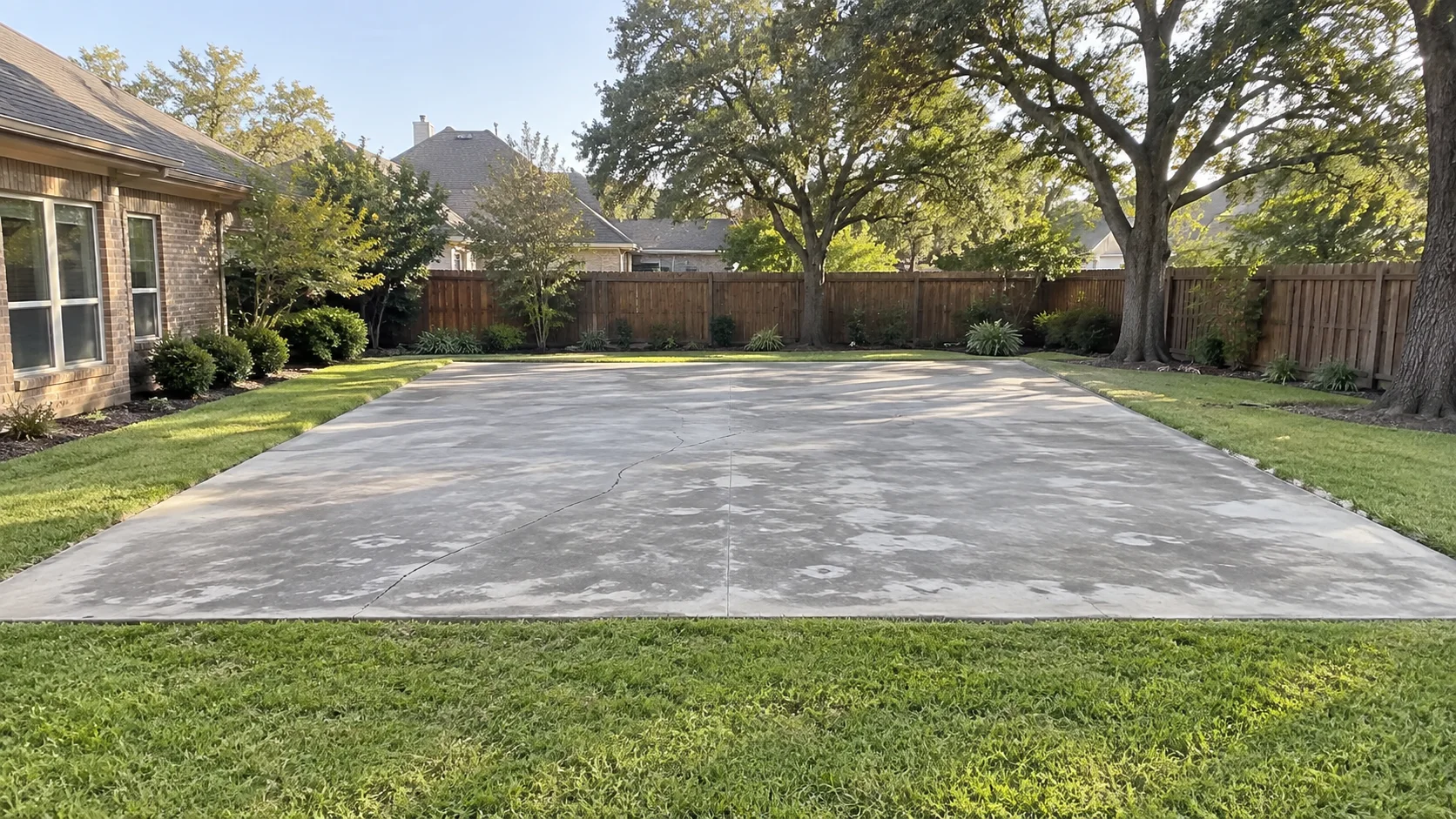
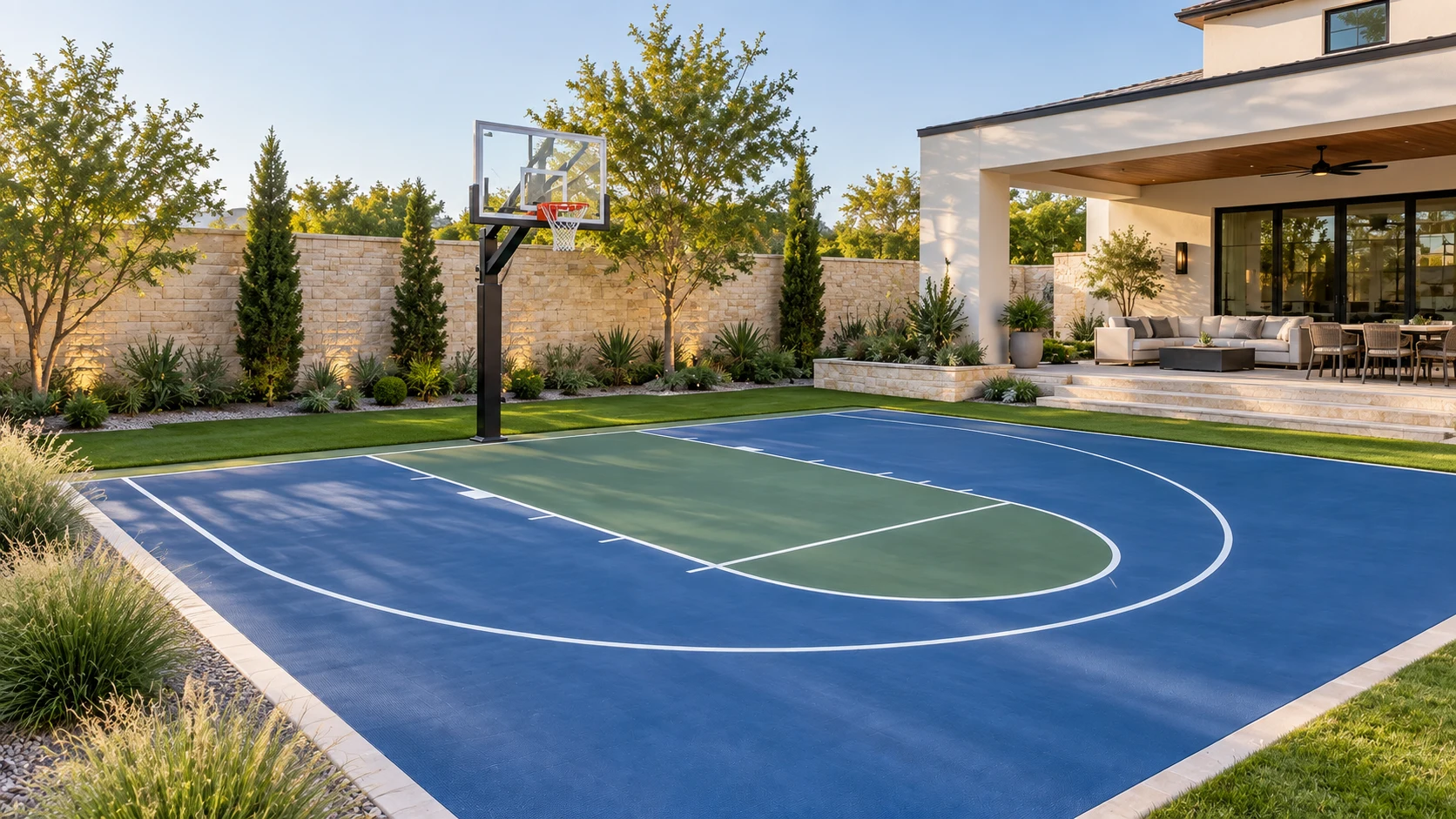
A broad driveway, recreation pad or retired court may provide a useful starting surface. We first review the concrete, drainage, dimensions and space for safe hoop placement.
These images show two different properties and illustrate the kind of starting pad and finished basketball court we can evaluate. Your design and scope will reflect your site.
Explore a Conversion RangeA basketball scope you can read before work starts
Name the surface system
We specify the Laykold system, surface preparation and color coats in the proposal so you can see what is included before work begins.
See our authorizationCompare matching assumptions
Share any competing proposal and we will line up its slab, preparation, coating and equipment assumptions with ours before comparing the totals.
Plan for the actual setting
We review court and surround colors together, including how the setting, sun exposure and planned playing times affect the choice.
Details that affect a possession
Texture underfoot
The specified coating texture influences traction and ball response. Discuss the intended users and play style before the surface system is finalized.
Consistent ball response
A well-prepared slab and consistent surface system support predictable play. If bounce changes noticeably across the court, the base and surface both deserve a closer review.
After-work playing time
A planned lighting system can extend useful playing time after dinner. Pole locations, glare control, electrical service and neighboring properties all belong in the early layout.
DFW basketball court planning questions
- What basketball footprint works in a DFW backyard?
- Start with the shots and drills you want, not a standard label. A 30 by 50 foot pad can support a compact half-court, while larger footprints provide more room beyond the arc and baseline. We place the hoop, playing lines and clear area on the property plan before recommending a size.
- How should I choose a residential backboard?
- A 72-inch board gives the most familiar full-size target. A 60-inch or 54-inch model may fit a compact practice area better. We compare the board material, pole offset, adjustment mechanism and footing requirements with the available space.
- Can an existing driveway become a basketball practice court?
- Sometimes. We check the usable dimensions, slope, joints, cracking and where a separate hoop footing could go. Vehicle access and the transition between driveway and play space also need to remain practical.
- How is a basketball hoop anchored at a Texas home?
- The anchoring method depends on the selected hoop, soil, slab and wind exposure. We coordinate the equipment requirements with the concrete plan instead of choosing a footing depth from a generic rule.
- What should we consider for summer play?
- Shade patterns, surface color, lighting and the hours your family expects to play all affect comfort. We review those choices together instead of making a temperature promise based on color alone.
- What controls the construction schedule?
- Access, earthwork, concrete design, curing, weather and the selected coating system all affect timing. An existing-pad conversion follows a different sequence from a ground-up court, so the written proposal should include the schedule for the actual scope.
Put your basketball plan on a real footprint
Choose the pad, hoop and supporting equipment in the estimator. We will use those selections to begin a property-specific conversation.
Build My Starting Range